Step-by-step removal, installation and commissioning.
Typical service life: 4 to 8 years. Many things affect how long an RO membrane element lasts, including exposure to chlorine and hydrocarbons, temperatures above 45°C, and other chemical and environmental extremes. Service conditions combined with time give each membrane its own service life.
Open Ocean only uses standard membrane elements. Replacements are available from us, and from RO system suppliers worldwide.
Tools and parts
A large Phillips screwdriver
A hammer or mallet
A long stick, like the handle of a deck brush
A short stick, about 200mm long and 20 to 40mm thick
An adjustable spanner
Teflon thread tape
A couple of dabs of silicone grease
A replacement membrane element
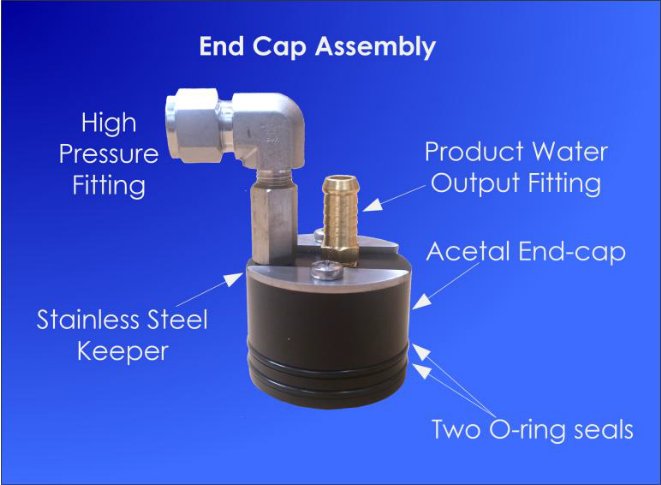
Membrane housing assembly.
Removing and installing the element
Disconnect the plumbing from the membrane. Loosen the cap nuts on the high-pressure tubes and remove them from the fittings. Loosen the hose clamp on the product water hose and remove it from its fitting.
Remove the membrane housing from its mounting and take it to your work area.
Remove all fittings from the end caps.
Remove the keeper fasteners and keepers.
With the membrane lying flat, use the short stick and mallet to tap on the end cap at the "Seal Intake" end. This pushes that end cap in, and the end cap at the other end out.
Once the "To Panel" end cap is free, set it aside. Grip the fresh water port on the membrane element and pull it out of the "To Panel" end of the housing. Note the O-ring seal on the element at the "Seal Intake" end.
Use the long stick from the "To Panel" end to tap out the "Seal Intake" end cap.
Unwrap the new element and smear a little silicone grease on its O-ring. Stand the membrane tube up on its "To Panel" end, on something soft such as a rug or folded towel.
Feed the element into the tube with the O-ring at the top. When the O-ring is about 250mm from the top of the tube, let go and let gravity draw it past the opening and the keeper slot. Make sure the O-ring is well seated inside the tube, and centre the element.
Apply a little silicone grease to the inner and outer O-rings on each end cap.
Orient the "Seal Intake" end cap with the ports where they were, normally with the high-pressure port towards the decals. Tap it in with a soft mallet, or with the short stick and a hammer. Stop when you can see both edges of the keeper slot.
Repeat with the "To Panel" end cap.
Refit the keepers and keeper fasteners.
Remove the old Teflon tape from the product water fitting and plug. Wrap them in fresh tape and refit, firmly but not over-tight.
Dab a little silicone grease on the O-rings of the high-pressure fittings. Wind them in until they stop, then back each one off until it lines up with your high-pressure tubes.
Remount the membrane housing and reconnect the high-pressure tubes and product water hose.
Commissioning the new element
Run seawater through the system for 10 minutes with the pressure off.
Bring the system up to pressure and run it for 15 minutes, discarding the sample water.
Taste-test the water, then either send it to the tank, or shut down and flush the system.